
Digital Marketing Budget Allocation: Where to Invest in 2026
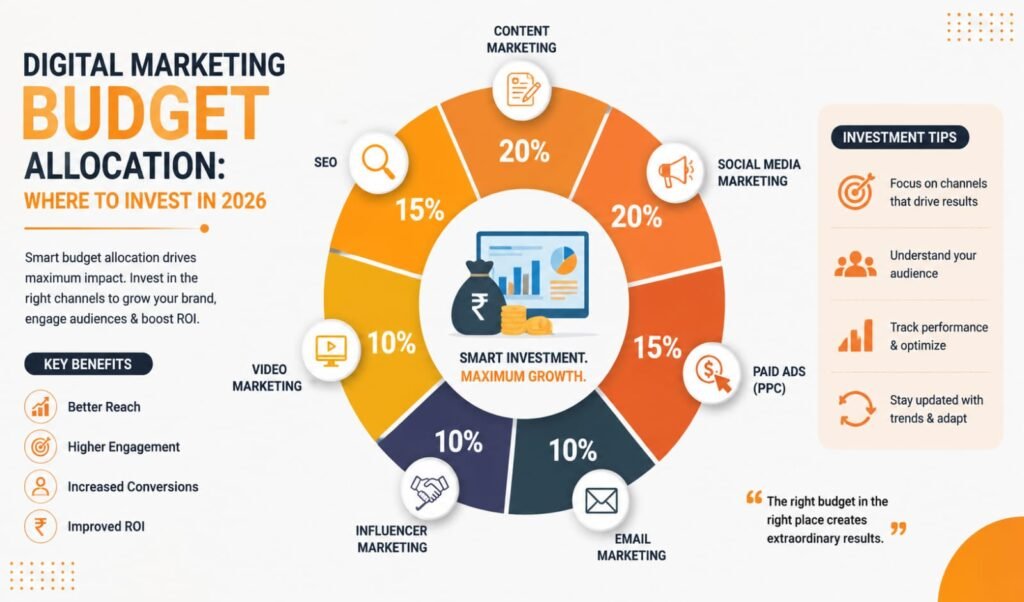
Hey there! Let’s chat about digital marketing budgets in 2026.
In 2026, having a digital presence is no longer a must-have. Businesses are fighting for attention on platforms like Google, Instagram, Facebook, LinkedIn, YouTube, websites, and even AIpowered search engines. With so many options, business owners are wondering where to invest their hard-earned money.
You might think that the size of your budget matters, but that’s not always the case. It’s how you allocate your budget that really counts.
A well-planned digital marketing budget in 2026 should strike a balance between generating immediate leads and building long-term brand visibility. It should also focus on organic traffic, customer engagement, and sustainable growth.
In this blog, we’ll explore where businesses should invest their digital marketing budget in 2026 and how to make every marketing rupee work harder. Stay tuned!
Hey there! Digital marketing has become a whole lot more involved than just throwing up some ads or posting on social media.
Imagine how a customer makes a buying decision these days. They might start by searching for a business on Google, then visit their website, check out their social media, read reviews, watch a YouTube video, compare competitors, and even use an AI-powered search engine before reaching out.
So, businesses need to think about the entire customer journey, not just one marketing channel.
The Cost of Marketing Without a Budget Plan
Without a proper plan, businesses often end up:
Spending too much on advertising
Posting on social media without a clear goal
Ignoring SEO because it takes time
Investing in unnecessary marketing tools
Running campaigns without tracking conversions
Focusing on likes and followers instead of leads
Sending traffic to a website that doesn’t convert
A good digital marketing budget for 2026 gives every channel a specific purpose.
For instance:
SEO → Getting found organically
Google Ads → Getting immediate search traffic
Social Media → Building brand awareness and engagement
Meta Ads → Generating demand and retargeting
Website → Making sales
AI & automation → Making things easier
The goal isn’t to spend more.
The goal is to spend smarter. —
2. How Much Should You Spend on Digital Marketing?
This is probably the first question most business owners ask.
Unfortunately, there’s no one-size-fits-all answer.
Hey there! Determining your ideal digital marketing budget for 2026 involves considering a few key factors.
First up, let’s talk about your business size. A local service business might get great results with a focused budget, while a national e-commerce brand might need a bigger investment.
Now, let’s compare small businesses and growing businesses. Small businesses should avoid trying to be everywhere. Instead, focus on where your customers are most likely to find you.
Here’s a quick breakdown of different types of businesses and their ideal marketing strategies:
Local service businesses: Google Business Profile + Local SEO + Google Ads
B2B companies: SEO + LinkedIn + Google Ads + Content
E-commerce businesses: SEO + Google Shopping + Meta Ads + Influencer Marketing
Education businesses: SEO + Google Ads + YouTube + Social Media
So, the right digital marketing budget for 2026 isn’t necessarily the biggest one. It’s the one that fits your audience and business goals.
Now, let’s talk about where to invest your digital marketing budget in 2026. A balanced marketing strategy usually involves several channels working together. Here’s a simple starting framework:
| Marketing Area | Suggested Allocation |
| ————————————————— | —————————: |
| Paid Advertising & Lead Generation | 40% |
| SEO & Content Marketing | 30% |
Hey there! Let’s talk about social media and brand building, as well as website, analytics, and technology.
Now, let’s say you’ve got a monthly marketing budget of ₹50,000. Here’s a rough idea of how you could allocate it:
₹20,000 – Paid Advertising
₹15,000 – SEO & Content
₹10,000 – Social Media
₹5,000 – Website & Technology
But remember, this is just a starting point, and it’s not set in stone.
Now, let’s talk about SEO. It’s like a long-term investment that can really boost your business’s visibility. If you’re in the B2B space, you might want to invest more in SEO and LinkedIn. If you’re an e-commerce company, you might need a bigger budget for paid advertising.
And here’s the thing: your digital marketing budget should change based on how things are going. If your SEO strategy isn’t working, you might need to adjust your budget accordingly. —
4. SEO: The Long-Term Investment Your Business Should Not Ignore
SEO is all about building long-term visibility, not just for the short term. It’s like a secret weapon that can help you reach a wider audience and grow your business.
Here’s how it works: when people search for products, services, questions, or solutions related to your business, your website should show up organically. That’s where SEO comes in.
For example, let’s say you’re a digital marketing company in Delhi NCR. You might want to rank for searches like:
Digital marketing company in Delhi NCR
SEO services in Delhi NCR
Social media marketing company
Google Ads agency
Website development company
Now, let’s talk about what an SEO budget might include. It could cover things like keyword research, competitor analysis, technical SEO, on-page optimisation, content creation, internal linking, backlink development, local SEO, Google Business Profile optimisation, website optimisation, and even AI search optimisation.
But here’s the thing: SEO takes time. It’s not a magic wand that can make your business overnight. But if you’re patient and consistent, you can see real results over time.
So, if you’re thinking about investing in SEO, don’t hesitate! It’s a long-term investment that can pay off big time.
Hey there! One of the most common misconceptions about SEO is expecting quick results.
SEO is a long-term game, my friend.
Search engines need time to crawl, understand, evaluate, and rank your website and content.
So, businesses should keep an eye on metrics like:
Organic traffic
Search impressions
Keyword visibility
Ranking improvements
Qualified enquiries
Organic conversions
Now, if you’re planning your digital marketing budget for 2026, SEO shouldn’t be seen as an expense that you can turn on and off like a light switch every few weeks.
Consistency is key, my friend! —
5. Google Ads and PPC: When You Need Faster Results
SEO takes time, my friend.
Paid advertising can help you get visibility much faster.
Google Ads can be especially helpful when potential customers are already searching for what your business offers.
For instance, someone searching for “website development company near me” has a much stronger commercial intent than someone casually watching a digital marketing video.
This is where PPC can become an important part of your digital marketing budget for 2026.
How Much Should You Spend on Google Ads?
Start with a small testing budget, just to see how it works.
For example:
₹500 per day × 30 days = ₹15,000 monthly ad spend
After running the campaign, take a look at:
Number of clicks
Cost per lead
Lead quality
Conversion rate
Sales generated
Return on Ad Spend (ROAS)
If the campaign is making you money, you can gradually increase your investment.
Hey there! If your campaign’s generating clicks but not qualified enquiries, increasing the budget might not be the best move.
First things first, let’s optimise the campaign. That’s where the magic happens!
Now, let’s talk about PPC vs SEO. It’s not always a black-and-white choice. Many businesses find that a strong strategy involves combining SEO for long-term growth with PPC for immediate opportunities.
Social media has also changed a lot. It’s no longer just about posting a poster every day. Businesses are using social platforms to build credibility, educate customers, create communities, generate leads, and even retarget potential buyers.
Your social media budget can include a mix of organic and paid strategies.
Organic social media involves content strategy, copywriting, graphic design, reels, videos, posting, community management, and engagement.
Paid social media includes Meta Ads, lead generation, traffic campaigns, engagement campaigns, remarketing, and conversion campaigns.
So, which platform should get more budget? That depends on your audience.
Here are some insights:
Instagram: Visual and consumer-focused businesses
Facebook: Local businesses and broad consumer audiences
LinkedIn: B2B, recruitment, and professional services
YouTube: Education, demonstrations, and video-led businesses
Don’t feel pressured to spend money on every platform. A smart digital marketing budget in 2026 should prioritise the channels where your target customers actually spend time.
Lastly, let’s talk about website design and development. Your website is your digital foundation, so it’s crucial to have a well-designed and user-friendly site.
Remember, it’s not about spending the most money; it’s about spending your money wisely and getting the best results.
Hey there! Imagine spending a whopping ₹20,000 on Google Ads and another ₹15,000 on social media, only to send all that traffic to a website that’s as slow as molasses and has no clear callto-action.
Your marketing investment can quickly go to waste, you know?
Your website is often the place where all that marketing traffic turns into actual business. So, it’s crucial to make sure it’s top-notch.
Now, let’s talk about what a website investment might include:
Website design
Development
Making sure it’s mobile-friendly
Creating landing pages
Optimising conversions
Technical SEO
Analytics
Security
Hosting
And regular maintenance
Now, here’s a question: when should you consider giving your website a makeover?
Well, if your website looks a bit dated, is hard to navigate, isn’t mobile-friendly, loads super slowly, has poor conversion rates, doesn’t really reflect your brand, or has technical SEO issues, it might be time for a redesign.
But hold on, a complete overhaul isn’t always the answer. Sometimes, just making some improvements to your existing website, landing pages, content, page speed, and call-to-action can yield better results at a lower cost.
That’s why website optimisation should definitely make it into your digital marketing budget for 2026. —
8. AI and Technology: The New Digital Marketing Investment
AI is shaking up how marketing teams work these days.
Businesses can now use AI to support a bunch of tasks, like:
Keyword research
Competitor analysis
Content research
Data analysis
Campaign reporting
Social media planning
Customer segmentation
And even marketing automation
But here’s the thing: AI can make marketing more efficient, but it doesn’t replace your marketing strategy.
A tool can help you generate some ideas, but it’s up to you to put them into action.
Hey there! I wanted to chat with you about something important. You know, AI tools can be a game-changer for small businesses, but they’re not a magic wand. They can’t do everything for you. They can’t understand your customers, your positioning, your competition, your pricing, your brand personality, or your business objectives. That’s where an experienced marketing team comes in.
Now, I’m not saying you shouldn’t invest in AI tools. But you should do it carefully. Before you add one to your digital marketing budget in 2026, ask yourself this question: “Will this tool save me time, reduce my costs, improve my performance, or generate me some extra income?” If the answer is no, then it might not be worth the investment.
Content marketing is another area where AI can be a real asset. In 2026, content is more important than ever. Why? Because good content can support multiple marketing channels at once. One well-researched article can become a blog post, a LinkedIn post, an Instagram carousel, a reel, a YouTube video, an email, and even AI-search content. That’s why content marketing is one of the most efficient ways to stretch your marketing budget.
So, what kind of content should businesses create? Well, the key is to create content that answers real customer questions. Think about things like how-to guides, industry insights, comparisons, case studies, FAQs, expert opinions, product/service explainers, and customer success stories. The goal is not just to publish more content, but to publish useful content that people actually want to read. This becomes especially important as businesses compete for visibility in AI-powered search.
Lastly, here’s a simple 40-30-20-10 digital marketing budget framework that you can use as a starting point. It’s a good way to get a sense of where to allocate your budget and what to focus on.
I hope this helps! Let me know if you have any questions.
Hey there! If you’re feeling a bit lost about where to start with your digital marketing budget for 2026, the 40-30-20-10 model is a great starting point.
40% – Paid Advertising
This is where you’ll spend your money on things like Google Ads, Meta Ads, lead generation, remarketing, and conversion campaigns.
30% – SEO and Content
Here, you’ll focus on SEO, blogging, keyword research, technical SEO, link building, local SEO, and AI-search optimisation.
20% – Social Media
This is where you’ll manage your social media accounts, create creative content, make reels, videos, engage with your community, and increase brand awareness.
10% – Website and Technology
This is where you’ll optimise your website, use analytics and tracking tools, invest in AI tools and automation, and make technical improvements.
Now, let’s say you have a monthly budget of ₹50,000. Here’s how it might look:
| Channel | Percentage | Amount |
| —————————— | ————: | —————: |
| Paid Advertising | 40% | ₹20,000 |
| SEO & Content | 30% | ₹15,000 |
| Social Media | 20% | ₹10,000 |
| Website & Technology | 10% | ₹ 5,000 |
| Total | 100% | ₹50,000 |
|But remember, this is just a guideline. Don’t be afraid to adjust your budget as you learn what works best for you.
—
11. How to Measure Your Digital Marketing ROI
A marketing budget only makes sense if you can measure the results.
Instead of asking, “How many people saw my advertisement?” you should ask, “How many qualified customers did my marketing generate?”
Some of the most important metrics to keep an eye on include:
Cost Per Lead
Hey there! Let’s dive into some key metrics that can help you make informed decisions about your digital marketing budget.
Total Marketing Spend ÷ Number of Leads: This metric gives you a clear picture of how effective your marketing efforts are in generating leads.
Customer Acquisition Cost (CAC): This metric helps you understand how much you’re spending to acquire each new customer. It’s important to keep this in check to ensure that your marketing efforts are cost-effective.
Conversion Rate: This metric measures the percentage of visitors who take the desired action, such as making a purchase or filling out a form. It’s a great way to track the progress of your marketing campaigns.
Return on Ad Spend (ROAS): This metric measures the profitability of your advertising efforts. It’s calculated by dividing the revenue generated by the advertising spend.
Now, let’s look at an example to illustrate these metrics. Say you spend ₹20,000 on advertising and generate ₹80,000 in attributable revenue. In this case, your ROAS would be 4X.
These metrics can help you decide whether to increase, reduce, or reallocate your digital marketing budget in 2026.
But wait, there’s more! Even businesses with great marketing teams can make costly mistakes. Here are some common digital marketing budget mistakes to avoid:
1. Spending Too Much on Ads: Just because you spend more doesn’t mean you’ll sell more. If your landing page, targeting, offer, or sales process is weak, increasing your budget can actually increase your losses.
2. Stopping SEO Too Early: SEO is a long-term game. If you stop after just a few months, you’ll miss out on the long-term benefits of your efforts.
3. Trying to Be Everywhere: You don’t need to be on every social media platform if your customers are active on only two. Focus your budget where the opportunity is.
4. Measuring Vanity Metrics: Likes and followers can be useful, but they shouldn’t be your primary business KPIs. Track:-
-Traffic
– Leads
– Customers
– Revenue
5. Ignoring the Website: Every marketing channel ultimately needs a place to send potential customers. Your website should support your advertising, SEO, social media, and content strategy.
6. Never Reallocating Your Budget: Don’t be afraid to reallocate your budget based on the results of your marketing efforts.
By following these tips, you can make sure that your digital marketing budget is working for you.
Hey there! Just a friendly reminder that your digital marketing budget for 2026 shouldn’t be set once in January and left to gather dust.
Regularly review your results to stay on track. If one channel is consistently delivering betterquality leads, consider boosting its allocation.
—
13. How Grotechie Can Help You Plan Your Digital Marketing Budget
Managing SEO, paid advertising, social media, websites, and AI-search optimisation all in-house can be a real head-scratcher.
That’s where having a strategic digital marketing partner can make a world of difference.
At Grotechie, we’re here to help businesses bring multiple digital marketing requirements under one umbrella strategy. We cover everything from SEO and AI Search Optimisation to Google Performance Ads, Meta Performance Marketing, social media management, YouTube Ads, website design and development, influencer marketing, and more.
But here’s the thing: we don’t just want to sell individual services. We want to understand which combination of services makes the most sense for your business.
For instance, let’s say you want to increase website traffic. You could start with SEO, then create a landing page, generate leads, retarget them, and finally, convert them into customers. Or, you could focus on social media to raise awareness, drive website visits, retarget users, and ultimately, generate leads.
When different channels work together, your digital marketing budget for 2026 can work more efficiently and effectively.
—
Frequently Asked Questions
What is a good digital marketing budget for a small business in 2026?
Hey there! When it comes to your digital marketing budget in 2026, there’s no one-size-fits-all answer. It all depends on your specific business, competition, customer acquisition costs, target market, and growth goals. Instead of spreading a small budget across every platform, it’s often better to focus on two or three relevant channels.
Here’s a helpful starting point: 40% of your budget should go towards paid advertising, 30% towards SEO and content, 20% towards social media, and 10% towards website and technology. But remember, these are just guidelines, and you should adjust them based on how your business is doing.
Now, let’s talk about SEO and Google Ads. Google Ads can help you get noticed faster, while SEO focuses on building a strong online presence that will grow over time. If you have the resources, you can combine both strategies for even better results.
Social media marketing is still super important in 2026. It’s a great way to reach your target audience, build brand awareness, and engage with your customers. Just make sure you’re targeting the right platforms for your audience.
And don’t forget about your website! It’s one of the most important assets in your digital ecosystem, and it needs to be optimised for search engines and users. Budgeting for ongoing maintenance and updates is essential to keep your website running smoothly.
AI can be a great tool for your digital marketing strategy. It can help you with research, content planning, data analysis, reporting, automation, and repetitive tasks. But remember, human strategy and decision-making are still important.
Finally, don’t forget to review your digital marketing budget regularly. Review your performance monthly and conduct a more detailed budget review quarterly. Shift your investment towards channels that consistently generate qualified leads and measurable business results.
—
Final Thoughts: Your Budget Doesn’t Need to Be Bigger—It Needs to Be Smarter
The biggest digital marketing mistake businesses can make in 2026 is thinking that success comes from simply increasing the budget.
It doesn’t.
Hey there! Let’s talk about your digital marketing budget for 2026. You’ve got a budget of ₹30,000, and you want to make the most of it. Here are some tips to help you achieve that:
1. Set a clear purpose: Make sure you have a clear idea of what you want to achieve with your digital marketing efforts. This will help you make the most of your budget and ensure that you’re getting the best results.
2. Invest in SEO: Search engine optimisation (SEO) is a great way to build long-term organic visibility. This means that your website will be more likely to rank higher in search engine results pages (SERPs).
3. Use Google Ads and Meta Ads: If you need to generate leads quickly, Google Ads and Meta Ads can be a great option. These platforms allow you to target specific demographics and interests, which can help you reach your target audience more effectively.
4. Use social media: Social media is a great way to build awareness, trust, and engagement with your audience. You can use platforms like Facebook, Instagram, and Twitter to reach a wider audience and connect with potential customers.
5. Invest in your website: Your website is the foundation of your digital marketing efforts. It’s where most of your digital traffic eventually converts, so it’s important to make sure it’s optimised for search engines and user experience.
6. Use content: Content is king in the digital world. By creating valuable and relevant content, you can attract and retain customers, and build a strong brand presence.
7. Use AI and automation: AI and automation can help you save time and money on your digital marketing efforts. You can use AI to automate tasks like email marketing and social media management, and automation can help you optimise your campaigns for better results.
8. Measure everything that matters: The most important thing is to measure everything that matters to your business. This will help you track your progress and make data-driven decisions.
The right question to ask when planning your digital marketing budget is not “How much should I spend on digital marketing?” but rather “Where can my marketing budget generate the highestquality business results?” This mindset will help you make the most of your budget and achieve your business goals.
If you need help deciding how much to allocate toward SEO, Google Ads, social media, website development, or AI-search optimisation, Grotechie can help you build a digital marketing strategy that’s tailored to your business goals.
Plan smarter, spend strategically, and grow consistently with Grotechie.
A helpful guide for businesses looking to optimize their marketing budget and ROI.